Amar Sagoo

7 April 2006

Interesting Typeface Facts

I've just discovered that many of the typefaces in Mac OS X include in their metadata very interesting narratives about their background and history. Just open Font Book and choose Show Font Info from the Preview menu. Arial, Futura, Times New Roman and Trebuchet MS are a few examples.

Times New Roman description

However, you would have hoped that Monotype know better than to put two spaces after their full stops.

30 March 2006

Renaming frustration

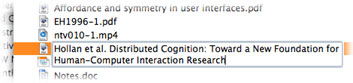
I've been downloading a lot of research articles recently. In order to be able to identify them easily, I like to put the author and full article title in the file name. Many of these articles have titles that sound like "Bla bla bla: A new model for bla bla bla", i.e. something containing a colon. Of course, the Mac doesn't allow using colons inside file names. Although annoying, I think this is forgivable. What is not forgivable, however, is that if you mistakenly include a colon, everything you've typed is lost and the file name is reverted back to what it was before you started:

The same thing happens if you try to use a name that's already used by another file.

Notice also that the message doesn't tell you what is wrong with the name, so novice users have to rely on trial and error to find acceptable file names.

What's going on, Apple? This is basic stuff!

29 March 2006

Can you feel the pain?

What better way to launch a new product than with a promise of maximal pain?

Licensed offers a place to put [your software licenses], and because it does nothing else, it does it very well. Every effort was taken to make entering details as quick and painful as possible.

I guess I'm not paying £3400 on a course about what makes software hard to use for nothing; I hope you can feel the difference.

21 March 2006

Debunking Myths about Student Life

Before I started my current MSc course, I was looking forward to the many pleasures commonly associated with student life: lots of time (or, in my case, lots of programming), lots of parties (or, in my case, lots of programming), etc.

How wrong I was! I could simply blame it on the workload, but I have to admit I don't really work that hard. No, it's the flexibility that really kills you.

When you're in a stable job, you can use your evenings and weekends as you please, you get real holidays, and you don't have to feel guilty about using those for non-work stuff. In fact, people will tell you off if you do use them for work stuff.

When you're a student, things are very different. Even during evenings, weekends and holidays, a cloud of guilt looms over you all the time, this feeling that you really should be reading some research article or text book. Even if you don't put in as many hours as in working life, you actually feel busier and more stressed because of this.

Thus I haven't been able to work nearly as much on my software as I was hoping to. I know, I know, it sounds like I'm just making excuses. But anyway, to make up for some of my creative absence, I put in a few hours to get Namely 2.0.3b1 ready for release. If you have an Intel Mac, please try this out and let me know if it works. If you don't, try it anyway.

13 December 2005

Brewster Kahle

Seeing this link about Amazon opening up the Alexa index today reminded me that I've been meaning to blog about Brewster Kahle, the father of Alexa and the Internet Archive.

There's an excellent interview with him on NerdTV. It's actually my favourite NerdTV episode so far. Many of the other guests talk a lot about their lives in general. Kahle, on the other hand, talks about what kind of place he wants the Internet to be, something he's very enthusiastic about. He's someone who really has vision, and who just generally seems to get the plot. It's strange he's not more famous.

Check it out.

18 November 2005

Namely 2.0

Finished sooner than expected, Namely 2.0 is now ready for your launching pleasure. The most obvious change is that it has a new, customisable look. I spent many hours (literally) tweaking the matte and shiny shading algorithms and the different colour presets. I hope it caters for the majority of tastes.

It is also smarter about how it orders matches. It will keep track of how often you launch which apps, and will give more frequently used ones precedence in the list. The result should be that you can open many of your favourites with just a single letter.

There are other changes as well, so check out the Read Me file.

17 November 2005

Have they never heard of scrollbars?

When Apple introduced the iTunes Music Store, one thing I hated about it straightaway were those views that have left and right buttons to page through a list of albums. At first I thought it was forgivable, given that the iTMS is more like a web site than a rich client interface. But after a short while I noticed that my eyes had become conditioned to move after clicking those arrows, trying to follow the animation. The problem is that they would never be in sync with the actual animation, especially since there's always a delay, which conjured up my old friend, motion sickness. I've now actually developed a habit of looking away right after clicking the arrows, and look back only after the animation is over.

When Tiger arrived, I was shocked to see the same awful paging view used in the Dashboard when you're adding widgets. The delay there is not nearly as bad as in the Music Store, but why on earth would you not use scrollbars for something like this?

It baffles me how Apple, out of all companies, keeps throwing decades worth of interface design wisdom out the window. They've done it with window title bar controls, with the Dock and with the Mail toolbar, to name just a few obvious examples. Jef Raskin once said that instead of interface architects, Apple has been infested with decorators. I think he had a point.